
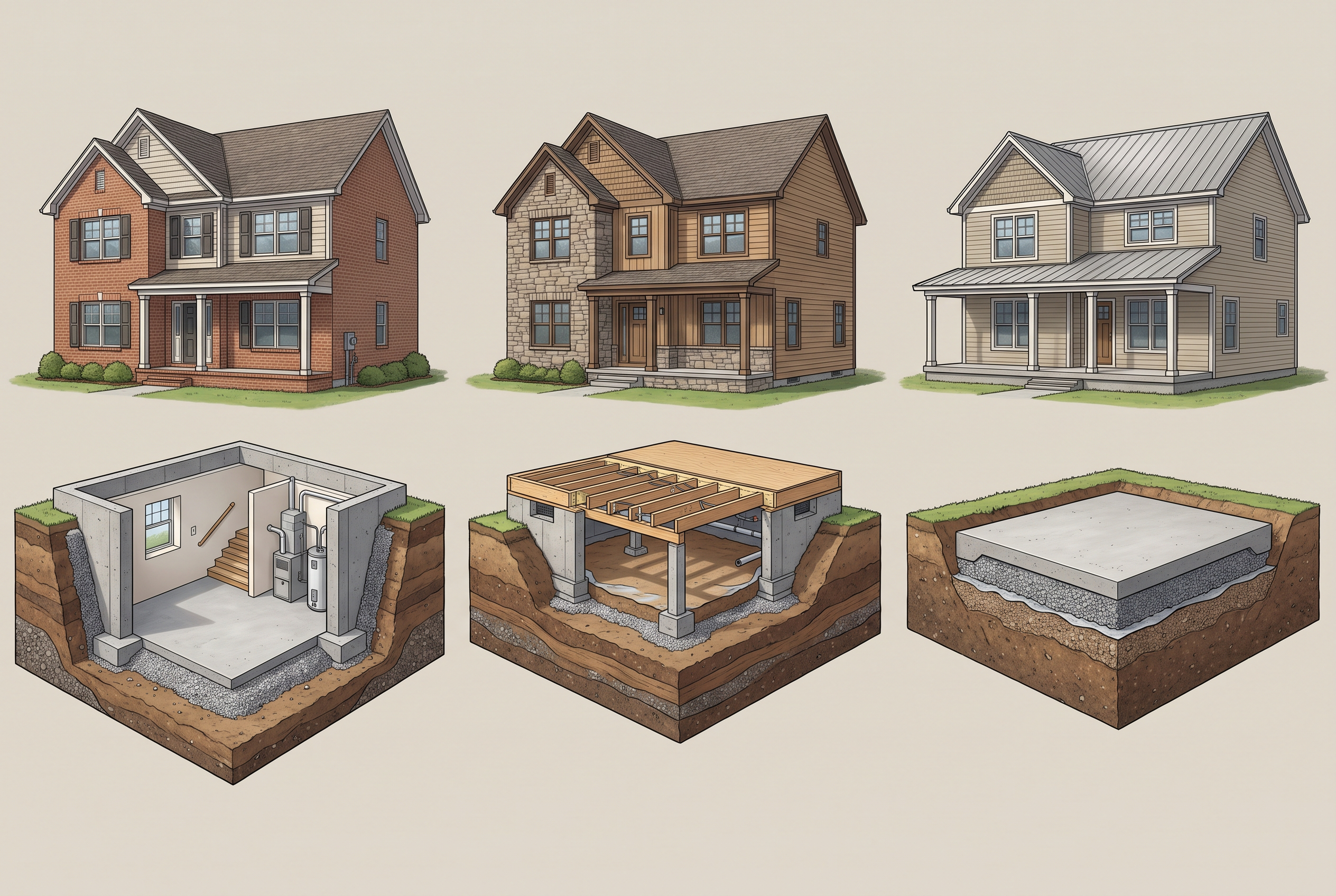
Basement vs Crawl Space vs Slab: What Works Best in Central Virginia?
Choosing between a basement vs crawl space vs slab is one of the bigger structural decisions homeowners may face when planning a custom home. Each foundation type has advantages, and the best choice depends on the land, home plan, budget, drainage, storage needs, and how you expect to use the space.
In Central Virginia, those decisions are especially tied to the property itself. Rolling terrain, red clay soil, wooded lots, seasonal moisture, and rural homesites can all influence which foundation makes the most sense. A foundation that works well on a flat lot near Lynchburg may not be the best choice for a sloped property in Bedford, Amherst, Campbell, or Appomattox County.
When a Basement Makes Sense
A basement can add substantial usable or unfinished space beneath the home. It may be used for storage, mechanical equipment, a workshop, recreation space, guest rooms, or future finished living areas.
Basements can be especially practical on sloped lots. When the land falls away from one side of the house, a walkout basement may allow full-size windows and exterior doors while taking advantage of the natural grade.
That is one reason basements are often worth considering on rolling Central Virginia properties. Instead of fighting the slope with extensive grading, the home can sometimes be designed around it.
Moisture management is critical, however. The U.S. Department of Energy’s Building Science Education resources emphasize controlling rainwater, groundwater, water vapor, and other moisture around basement foundations.
Craftsman Custom Home Builders uses poured concrete basement walls along with foundation coating and drainage systems. You can review their current home specifications for more information about foundation construction and basement standards.
Why Crawl Spaces Are Common in Central Virginia
Crawl spaces are a familiar foundation choice throughout Virginia. They elevate the main floor above the ground while creating accessible space beneath the home for plumbing, wiring, ductwork, and other systems.
Compared with a full basement, a crawl space generally requires less excavation and concrete. It can therefore make sense on lots where homeowners do not need basement storage or living space.
The main consideration is moisture. Water vapor can move from the soil into a crawl space and contribute to damp framing, condensation, mold, or wood deterioration if the space is not managed correctly.
The Department of Energy recommends a continuous ground vapor barrier as part of crawl-space moisture control, along with proper grading and drainage around the home. Their crawl-space moisture guidance explains how ground covers and drainage help limit moisture entering from the soil.
For Central Virginia’s humid summers and moisture-prone soils, those details matter considerably more than simply deciding whether the crawl space has vents.
When a Slab Foundation Can Be a Good Choice
A slab foundation places the home on a concrete slab poured close to ground level. It eliminates the crawl space or basement beneath the house and can simplify the foundation on suitable sites.
Slabs often work best on relatively level properties where major elevation changes are not required. They can be practical for smaller homes, cottages, or homeowners who prefer single-level living without steps between the yard and main floor.
Moisture still needs to be considered. The Department of Energy recommends drainage material and a vapor barrier beneath slabs to help prevent ground moisture from migrating into the concrete and home. You can review its guidance on moisture protection beneath slabs.
One tradeoff is access. With no crawl space or basement, plumbing and other systems located beneath the slab are less accessible if repairs or modifications are needed later.
The Slope of the Lot Can Make the Decision Easier
For many Central Virginia homesites, the land itself quickly narrows the choices.
A relatively flat lot may work well with a slab or crawl space. A moderate slope may favor a crawl space with varying foundation wall heights. A stronger slope may create an opportunity for a basement or walkout basement.
This is why it is better to evaluate the property before becoming attached to one foundation type. The goal is to work with the natural grade when possible rather than paying to dramatically reshape the land.
If you are considering a hillside property, read our guide to building on a sloped lot for more on grading, drainage, driveways, and home placement.
Moisture and Drainage Matter With All Three
There is no foundation type that makes water management irrelevant.
Basements need exterior drainage and waterproofing or damp-proofing systems. Crawl spaces need ground moisture control and proper drainage. Slabs need appropriately designed vapor and capillary breaks beneath the concrete.
Site grading is just as important. Water should move away from the foundation instead of collecting beside it, regardless of whether the home sits on a basement, crawl space, or slab.
Radon is another consideration worth discussing when planning the foundation. The EPA recommends radon testing for all homes, regardless of the foundation type or the radon zone assigned to the county.
Think About Storage, Mechanical Access, and Future Use
Foundation decisions affect more than construction.
A basement offers the most potential storage and future usable space. A crawl space provides access to many building systems without adding a full lower level. A slab provides neither, so storage and mechanical equipment need to be planned elsewhere in the home.
Homeowners should also consider long-term plans. An unfinished basement today might become finished living space years from now. Someone planning to age in place may prefer a slab or crawl-space home with easy main-level access.
Craftsman’s custom home plans include examples designed for different foundation types, and plans can be modified to fit both the homeowner and the property.
There Is No Universal “Best” Foundation
When comparing a basement vs crawl space vs slab, the right answer is usually the one that fits the land and the way you want to use the home.
For a flat, straightforward homesite, a slab or crawl space may be practical. For rolling land, a basement may make better use of the grade and create valuable additional space. On other properties, site conditions, drainage, budget, or home design may point clearly toward one option.
That decision is easier to make after the property and home plan are considered together. Craftsman Custom Home Builders offers lot inspections and site-preparation estimates as part of the process of building within its service area.
If you are considering building a home in Central Virginia, the Craftsman team can help evaluate your land, review foundation options and home plans, and provide transparent pricing before construction begins. Start the conversation through the contact page.
FAQ
Is a basement better than a crawl space in Virginia?
Not necessarily. A basement provides more usable space and may work especially well on a sloped lot, while a crawl space can require less excavation and still provide access to plumbing and mechanical systems.
Are slab foundations good in Central Virginia?
They can be. Slabs can work well on relatively level properties when drainage and under-slab moisture control are properly designed.
Which foundation works best on a sloped lot?
A basement or walkout basement can often make good use of a significant slope, although the best option depends on the specific grade, home plan, drainage, and budget.
Does foundation type affect radon risk?
Radon can enter homes through foundation openings and penetrations regardless of foundation type. The EPA recommends testing all homes for radon rather than assuming a particular foundation eliminates the risk.
